 By Louis Marie Kakdeu
Despite the commissioning of the Nachtigal Dam (420 MW) in 2025, Cameroon’s energy deficit persists, highlighting the limits of a policy that is overly centralized and heavily dependent on hydropower.
There can be no industry without energy. This statement is particularly true in Cameroon, where the Edéa I hydroelectric power plant was built in 1953, among other purposes, to supply electricity to the electrochemical industry of ALUCAM. Since then, however, energy development has not kept pace with population growth, which has remained around 3% per year since the 1970s.
For more than twenty years, the country has been plagued by frequent power outages that slow down economic activity. In public debate, the question is no longer WHO IS TO BLAME: the lack of investment and shortcomings in asset management, inherited from the creation of the National Electricity Company of Cameroon (SONEL) in 1974, are well known. The pressing question remains: how can this problem be sustainably resolved?
Government policy
In 2014, Cameroon’s electricity supply was estimated at 1,337 megawatts (MW). The government set an ambitious target of increasing production to 2,000 MW by 2015–2016, and then to 6,000 MW by 2030. Today, in 2026, total installed capacity stands at around 1,650 MW—a real improvement, but still far below announced targets.
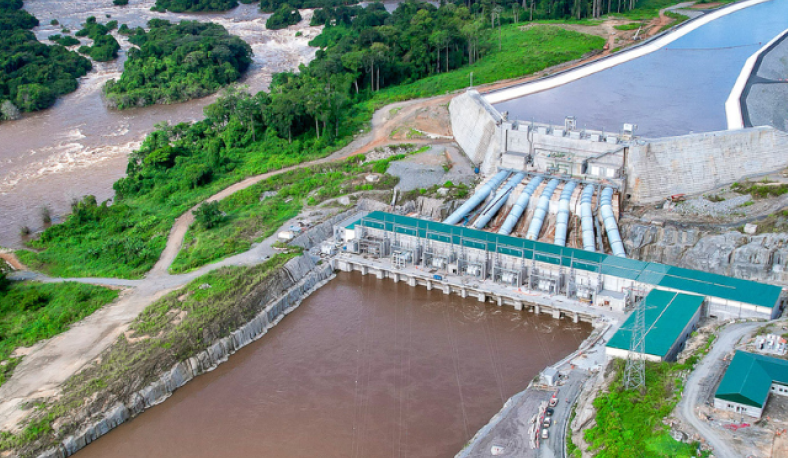
The flagship project of this decade is undoubtedly the Nachtigal hydroelectric dam (420 MW), financed at a cost of 786 billion CFA francs on the Sanaga River. Fully operational since March 2025, it increased national production capacity by about 30% in a single step. The National Development Strategy (NDS 2020–2030) now targets 5,000 MW of installed capacity by 2030, with additional projects under study or development: Song Dong (270 MW), Menchum (72 MW), Bini at Warak (75 MW), Grand Eweng (1,800 MW in the long term), and a 250–300 MW plant at the foot of the Mbakaou reservoir dam.
In addition, two major solar plants totaling 30 MW have been commissioned, and more than 360 off-grid solar mini-plants have been deployed in rural areas under the National Solar Energy Promotion Program. Rural electricity access reached around 40% in 2023, compared to less than 20% a decade earlier. This is notable progress, but still insufficient.
However, the relevance of these advances is being seriously questioned. In November 2025, the state renationalized ENEO (Energy of Cameroon), buying back the 51% stake held by British fund ACTIS for 78 billion CFA francs, while inheriting nearly 800 billion CFA francs in debt. ENEO, which holds a monopoly over distribution and manages 44 power plants, generates monthly revenues of about 30 billion CFA francs against commitments of nearly 50 billion. Tariffs, frozen by the regulator ARSEL since 2012, force the distributor to charge below cost, creating an implicit subsidy estimated between 70 and 100 billion CFA francs for 2025 alone.
The centralization trap
The renationalization of ENEO and the strengthened role of SONATREL (National Electricity Transmission Company) reflect a persistent trend toward recentralization. Yet this model—producing energy in one part of the country and transporting it at great cost to another—has shown its limits. Around 40% of energy is lost during transmission due to aging infrastructure.
Cameroon is not a homogeneous reality from an agro-ecological standpoint. A single, uniform approach across the entire territory is therefore structurally inadequate. The solution to the electricity problem must be local, rooted in the specific characteristics of each region. This is a principle that decentralization, promised since the 1996 Constitution, has never truly achieved.
A diverse but underexploited potential
Cameroon has a remarkable and largely untapped energy potential. Its solar capacity is estimated at 89.25 TWh—five times greater than its hydropower potential (19.7 TWh). Yet in 2024, solar accounted for only 30.83 MW of installed capacity out of a total of 1,562 MW, or less than 2%.
In addition, the country has around 300 exploitable small hydropower sites (potential of 1.115 TWh); significant geothermal potential along the volcanic fault line crossing the country; untapped wind resources in areas such as Kaélé, Lake Chad, and the Bamboutos Mountains (with Harmattan winds reaching 6 m/s); vast forest biomass resources, with 17.4 million hectares—making it the second-largest forest area in the Congo Basin—as well as near-limitless biogas potential. Its 402 km Atlantic coastline also offers opportunities for marine energy.
In May 2024, during the Forum on the Promotion of Renewable Energy, the Minister of Water and Energy announced the ambition to increase the share of renewables (excluding large dams) to 25% of the electricity mix by 2035, or about 1,500 MW of additional capacity. A commendable goal, but one that requires a strong legislative and incentive framework—still largely lacking.
A legal gap as a structural barrier
Law No. 2013/004 of April 18, 2013, aimed at encouraging private investment, was already considered insufficiently ambitious when adopted and still awaits full implementing decrees. The effective liberalization of the sector, established by Law No. 2011/022, ended SONEL’s historical monopoly, but the renationalization of ENEO in 2025 once again raises questions about the balance between public regulation and private initiative.
A positive signal emerged with Ordinance No. 2025/002 of July 18, 2025, which introduces new incentives for investment in renewable energy and clean cooking. The government has also committed to adopting a mini-grid code by the end of 2026 to facilitate deployment by private actors. However, these advances remain to be implemented, and the pace of structural reforms in Cameroon calls for caution.
Governance, tariffs, and maintenance: the crisis triangle
The commissioning of Nachtigal should have marked the end of power rationing. This is not yet the case, mainly for two reasons. First, the transmission network, managed by SONATREL, suffers from chronic underinvestment, preventing it from evacuating all the energy produced. Second, the sector’s financial crisis—marked by frozen tariffs since 2012 and massive inherited debt—makes maintenance investments difficult.
Decentralization remains the cornerstone of more effective energy governance: it would strengthen participation, representation, and accountability of citizens and municipalities in local energy management. At the same time, the state must implement incentive-based taxation on solar equipment, energy-saving bulbs, and construction materials that promote energy efficiency, while undertaking a deep reform of the tariff framework to make it sustainable.
Megawatts—yes, but not just any kind
Cameroon has made significant progress: installed capacity has nearly doubled since 2014, Nachtigal is now the largest hydropower project in sub-Saharan Africa under a public-private partnership, and the country aims to export electricity to Chad by 2027. Yet this momentum hides deep structural weaknesses: an aging transmission network, massive sector debt, tariffs disconnected from real costs, and excessive dependence on hydropower in a context of increasing climate variability.
Rather than centralizing everything around large dams, the state must urgently create conditions for private investors and local authorities to work together toward nationwide electrification. This requires an ambitious renewable energy law, an operational mini-grid code, a bold tariff reform, and full implementation of decentralization laws. Without these deep reforms, each new megawatt installed risks being absorbed by losses, debt, and ever-growing unmet demand.